Kawita Vatanajyankur: Memory Machine
May 8 – August 30, 2026
Yuz Project Space of Art
Yuz Museum
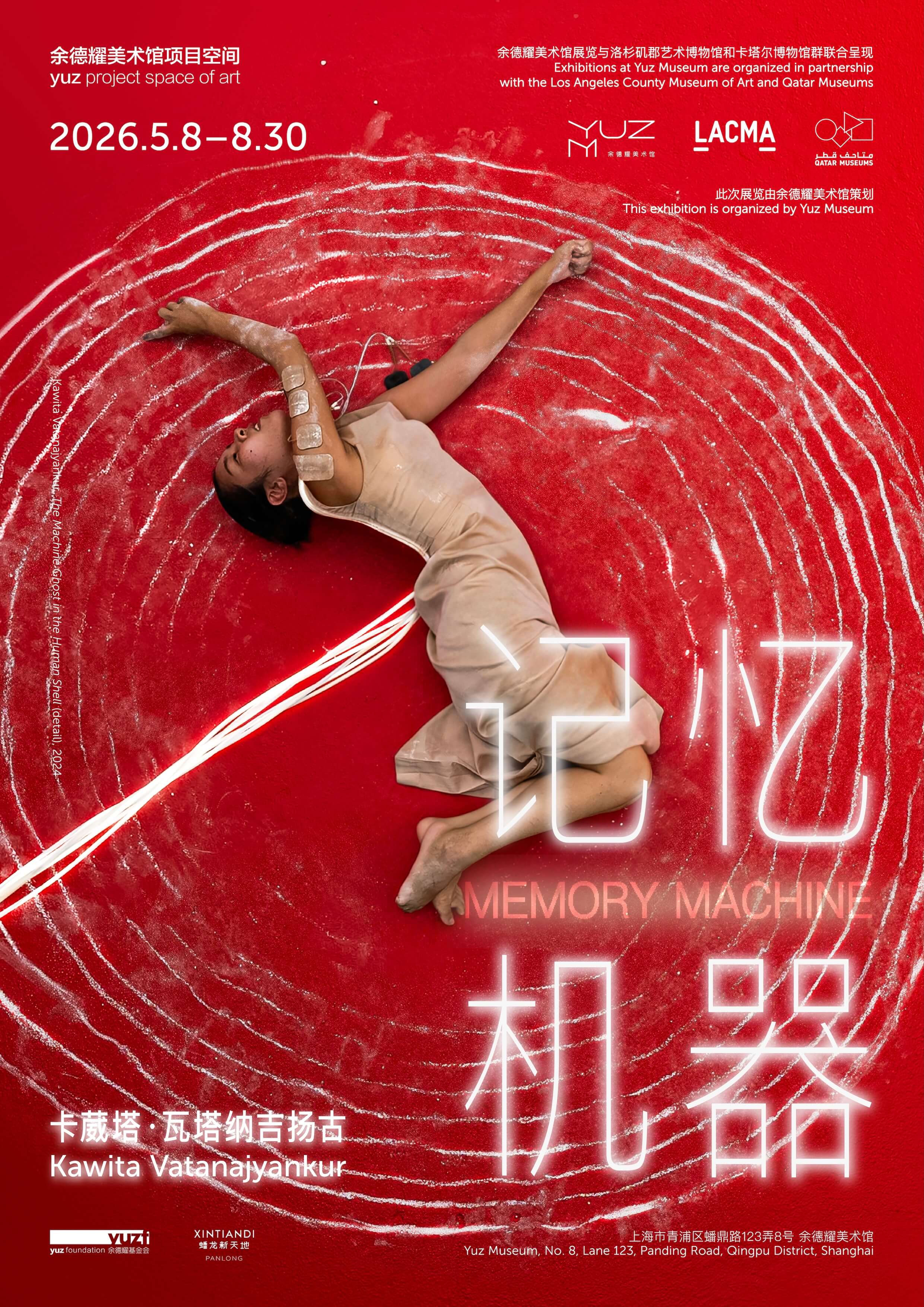
From May 8th to August 30th, 2026, Yuz Museum is pleased to present Memory Machine, the first solo exhibition in China by Thai artist Kawita Vatanajyankur. This exhibition also marks her first major institutional presentation globally in nearly four years. Featuring six representative works created between 2018 and 2025, it offers an in-depth survey of her long-term observations and critical reflections on the continuous evolution of human labour. In “Memory Machine,” her latest series commissioned by Yuz Museum, she pivots her creative focus from “machinized human” to the exploration of “humanized machine.” This shift not only extends her investigation of human self-alienation, but also delves into how artificial intelligence and digital heritage reconstruct human memory and emotional boundaries within a post-human context, fostering a more universally spiritual “connection.”
At the intersection of labour, gender, and technology, Vatanajyankur’s practice consistently employs her own body as a medium to reveal structural injustices and systemic imbalances in contemporary society—often obscured by the veneer of daily life and consumerism. In her early series such as “Tools,” “Performing Textiles,” and “Fieldwork,” she objectifies herself as household, textile, or agricultural implements, mimicking relentless operation of machinery through distorted postures and repetitive movements. These performative videos are characterized by a highly recognizable visual language of vibrant colors with high-saturation and minimalist compositions. This is not only a natural choice after Vatanajyankur’s early studies in painting and her connection with film influenced by her family, but also a carefully orchestrated aesthetic strategy: she deliberately imbues her works with a dazzling tension, like commercial advertisements. By doing so, she lures the viewer’s gaze beyond the seductive surface to confront the core of the work. Beneath the alluring visuals, she tears apart the layers of reality hidden behind social structures and consumerism, sharply criticizing the inhumane state of women and working-class labourers, who are objectified and mechanized, as well as the systematic neglect, underestimation, and exploitation of their labour within the “invisible structures” of domestic life and society. This unwavering pursuit of justice and fairness forms the unshakable foundation of her work. Moreover, her practice goes beyond mere imitation of labour or the plight of labourers, but rather a way of “bodily autonomy” and introspection, reclaiming self-identity and self-recognition through the continuous limit testing of physical endurance.
In recent years, Vatanajyankur has shifted her focus from revealing the alienation of humanity through “mechanization” in traditional manual labour, to exploring how technology reshapes labour and dominates human behavior and psychology in the digital age. In collaboration with Pat Pataranutaporn from the MIT Media Lab, her “Cyber Labour” series utilizes AI and electrical muscle stimulation to directly manipulate her body, transforming herself into a human-machine hybrid. In The Machine Ghost in the Human Shell (2024), as electrical pulses distort her movements and the voice of AI permeates her thoughts, Vatanajyankur continuously resists the control exerted by the AI-driven machine through acute self-perception and self-awareness. As a metaphor for humanity’s struggle against the surveillance, exploitation and domination of networks and algorithms, she questions whether this fusion of human and machine is a path to liberation or evolves into a new pervasive yet ubiquitous form of oppression.
Building upon “Cyber Labour,” Vatanajyankur launches the new series “Memory Machine” for this exhibition to further explore whether AI can serve as a symbiotic medium and labour for emotional transformation and a carrier of memory and spiritual continuity. This series, a collaboration between the artist and her mother Pam Vatanajyankur, is an intergenerational exploration of bereavement and family memory. In Echoes (2025), the artist suspends herself upside down as a bell stick, striking the golden bell with her body. A generative AI, trained on her late father’s writings, emits Morse code-like pulses that orchestrate the rhythm of her body striking the bell. For Vatanajyankur, the AI system does not simulate her father’s voice, but rather performing a form of machinic inheritance, producing a non-human agency shaped by the traces of the deceased. Her father is not present, yet he continues to transmit; the artist could connect and resonate with him through each echo of the strike. The lightbox installation Flight (2025) emerges from Echoes, in which Vatanajyankur holds her body taut like an arrow, frozen between the act of drawing and releasing a bow, metaphorically representing the contradiction and tension between holding on and letting go, restraint and release. A philosophical dialogue between two machine minds forms the sound portion of the work, showcasing diametrically opposed views: is memory a necessary foundation of existence, or a heavy shackle that binds freedom and hinders rebirth?
In My Mother and (A)I (2025), Vatanajyankur’s mother cradles her daughter, whose body is poised as a living paint brush, painting on the ground with ashes. Electrodes are connected to her muscles, signaled by AI trained from her father’s written memories, guiding the artist’s arm movements through electrical pulses. The mother’s gentle movements intertwine with the machine’s precise guidance, and the father’s invisible presence is awakened through the daughter’s body, achieving a reunion across time and space. Accompanied by the mother’s breathing, an AI-generated voice softly recites a monologue of machine on memory and forgetting, existence and disappearance.
Through the creation of these works in “Memory Machine,” Vatanajyankur explores the co-existing dimensions between human and machine where the “machinized” body becomes an orchestrating vessel of the past, evoking buried memories to be reconciled, acknowledged and accepted. She also invites us to further reflect on how individuals find and define their own existence in this digital reality.
About the Artis
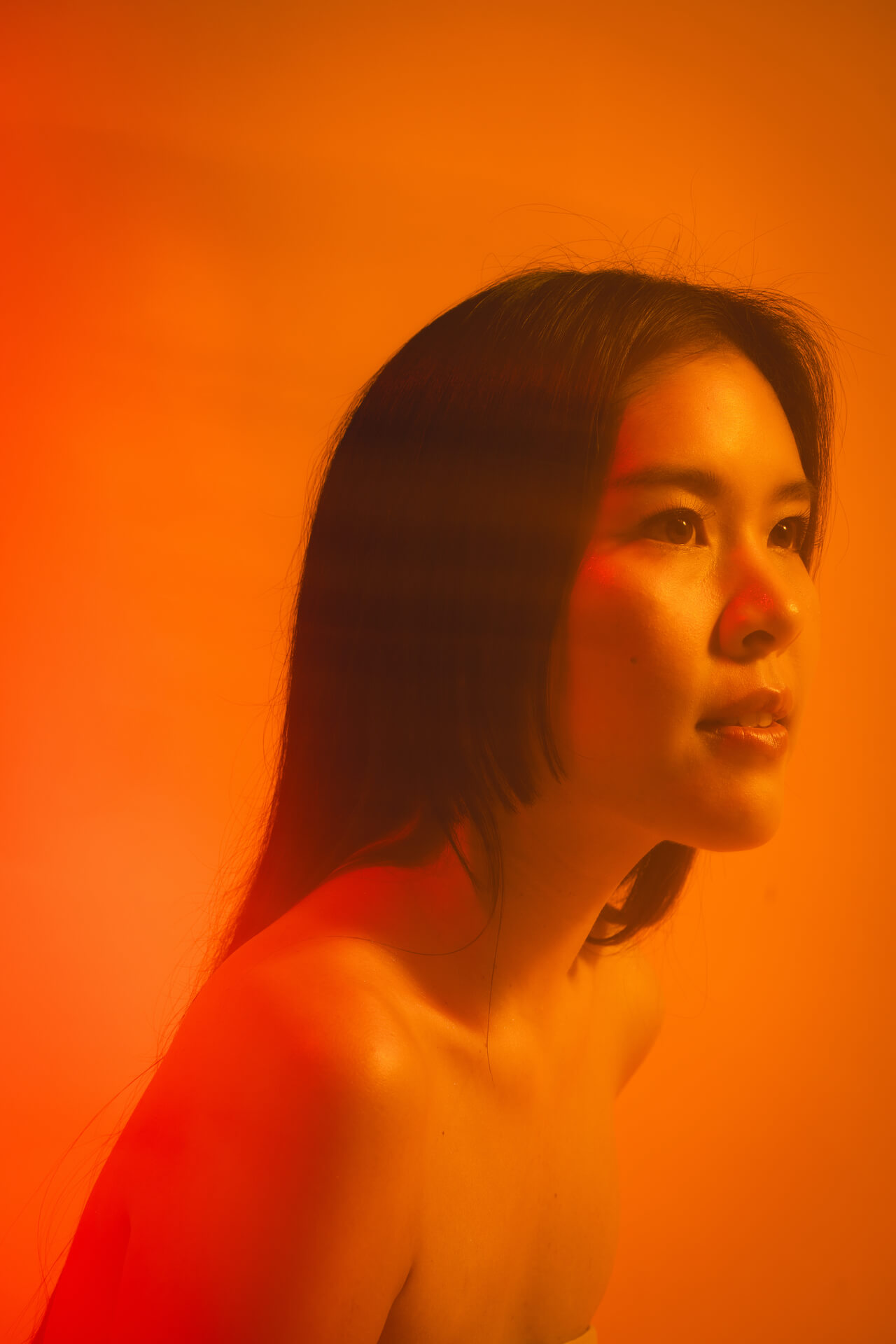
Kawita Vatanajyankur (b.1987, Bangkok, Thailand) has achieved international recognition since graduating with a BA in Fine Art from RMIT University in 2011. In 2015, she was a Finalist for the Jaguar Asia Tech Art Prize and was included in the Thailand Eye exhibition at the Saatchi Gallery, London. Her work was later presented in Islands in the Stream in Venice, alongside the 57th Venice Biennale (2017). That same year, she exhibited at both the Asia Triennale of Performing Arts and the Asian Art Biennial.
In 2018, Vatanajyankur participated in the inaugural Bangkok Art Biennale and presented her work in Absurdity in Paradise at the Fridericianum Museum in Kassel. The following year, she held her largest museum exhibition to date, Foul Play, at the Albright-Knox Art Gallery in New York. In 2021, she took part in Collecting Entanglements and Embodied Histories at both MAIIAM Contemporary Art Museum and Hamburger Bahnhof, where her work was also featured in the exhibition Balance.
She returned to the Bangkok Art Biennale 2022, while also presenting in Fun Feminism at Kunstmuseum Basel and The Uncanny World at the Museum of Contemporary Art Busan. In 2023, Vatanajyankur was introduced by Nova Contemporary with a solo booth at the Discovery Section of Art Basel Hong Kong. In 2024, she presented works in The Spirits of Maritime Crossing, an official collateral exhibition of the Venice Biennale, and was selected for the 11th Asia Pacific Triennale in Brisbane.
In May 2026, she will present a major solo exhibition Memory Machine at Yuz Museum in Shanghai, and participate in the upcoming NGV Triennial 2026 in Melbourne.
Vatanajyankur has exhibited widely across Australia, Asia, the United States, and Europe. Her works are held in the National Collection of Thailand and in leading institution collections including the Queensland Art Gallery and Gallery of Modern Art (QAGOMA), Singapore Art Museum, JUT Art Museum, M Woods Museum, Dunedin Public Art Gallery, MAIIAM Contemporary Art Museum, DIB Contemporary Art Museum, MOCA Bangkok, and Yuz Foundation. Her practice is also represented in university collections and private collections across Asia, Europe, Australia, New Zealand, and the United States.
About Yuz Project Space of Art
Yuz Project Space of Art (PSA) is an independent program launched in partnership with Yuz Museum in September 2015. Known for public-access, Yuz Project Space of Art invites artists to create site-specific works or projects where it engages boldly with the museum, the surroundings and audiences. Combining “a project + an exhibition,” the program aims to present the interaction between the artists, time, and space.
Yuz Project Space of Art is where innovation and creation cross path. It provided an innovative platform for artists, both Chinese and international, to use this space to generate conversations toward each other with their own unique and groundbreaking artworks. Furthermore, the space invites artists to breakthrough their usual practice and explore all kinds of possibilities of contemporary art.
Exhibitions at Yuz Museum are organized in partnership with the Los Angeles County Museum of Art and Qatar Museums

Made Possible by Yuz Foundation
Yuz Museum
Yuz Museum, officially opened in May 2014 in Shanghai, is a contemporary art museum founded by Mr. Budi Tek, a Chinese-Indonesian entrepreneur, philanthropist, and collector. As one of the first non-profit institutions along the West Bund Culture Corridor, the museum has been following its founder, Budi Tek’s philosophy of “collecting to share”, with the mission of “drawing the world’s attention to Shanghai” and “bringing art into people’s daily lives”. Committed to advancing the development of contemporary Chinese art, actively engaging in the field of art education, and promoting cultural dialogues between East and West as its own responsibility, and exploring to answer the question “It takes ten years to grow trees, a hundred years to grow people, then how many years to grow a life of art?” By doing so, it has successfully established a bi-directional parallel between “history” and “future” throughout all its exhibitions and developed a variety of public outreach programs. It introduces the Chinese public to contemporary art and the world to Shanghai and China through its exhibitions that span across China and the West.
Since its opening, Yuz Museum has been the home of many internationally acclaimed exhibitions such as the world’s largest “Giacometti Retrospective,” the “Rain Room,” the Asia premieres of Andy Warhol’s “Shadows,” KAWS’s “Where the End Starts,” “Charlie Chaplin: A Vision,” “Yoshitomo Nara,” “Watering the Desert: Contemporary Art from Qatar,” and etc., which have had a great impact on domestic and international culture, art, education, and other fields.
Yuz Museum has been active in the world of art and has launched in-depth collaborations with many internationally renowned art museums. On October 31, 2019, Yuz Museum Shanghai entered into a landmark collaboration with the Los Angeles County Museum of Art and Qatar Museums to jointly develop and share exhibitions and programs across their institutions.
With its continual development, the museum has been looking into possibilities of further expansion and made its home in the core area of Shanghai Greater Hongqiao International Business District. On May 17, 2023, as the new venue of Yuz Museum at Panlong Xintiandi was completed and opened to the public, the museum launched the 2nd phase of its strategic plan: YUZ FLOW. In the coming ten years, the museum will carry on with Mr. Budi Tek’s philosophy, further explore how to use “art to grow generations to come”, take “flow with Yuz, breathe with art” as its vision for the 2nd stage, and make a gradual layout shift from a “white box” to a “satellite network”, marking the start of the museum’s 2nd chapter with a brand-new model: “one main space + various encounters”.
In 2024, the Yuz Museum launched a children’s art education project – YUZ DOLAN, which has been planned and developed by our expert and innovation team for many years. “DOLAN” is derived from the Indonesian Javanese language, meaning “play”, and its opening will reshape the museum space into an “art playground” for the participants. Specifically tailored for children, this project is launching diverse content ecosystems including creative art courses, art museum education charity events, and artist’s workshops, which are deeply rooted within the Yuz Museum’s professional experience in art exhibitions, research collections, and public education. We are committed to creating an artistic paradise for children to grow happily, express themselves, and unleash their creativity.
For more information, visit www.yuzmshanghai.org
LACMA
Located on the Pacific Rim, LACMA is the largest art museum in the western United States, with a collection of more than 150,000 objects that illuminate 6,000 years of artistic expression across the globe. Committed to showcasing a multitude of art histories, LACMA exhibits and interprets works of art from new and unexpected points of view that are informed by the region’s rich cultural heritage and diverse population. LACMA’s spirit of experimentation is reflected in its work with artists, technologists, and thought leaders as well as in its regional, national, and global partnerships to share collections and programs, create pioneering initiatives, and engage new audiences.
For more information, visit www.lacma.org
Qatar Museums
Qatar Museums (QM), the nation’s preeminent institution for art and culture, provides authentic and inspiring cultural experiences through a growing network of museums, heritage sites, festivals, public art installations, and programmes. QM preserves and expands the nation’s cultural offerings, sharing art and culture from Qatar, the Middle East, North Africa, and South Asia (MENASA) region with the world and enriching the lives of citizens, residents, and visitors.
Under the patronage of His Highness the Amir, Sheikh Tamim bin Hamad Al Thani, and led by its Chairperson, Her Excellency Sheikha Al Mayassa bint Hamad bin Khalifa Al Thani, QM has made Qatar a vibrant centre for the arts, culture, and education in the Middle East and beyond. QM is integral to the goal of developing an innovative, diverse, and progressive nation, bringing people together to ignite new thinking, spark critical cultural conversations, and amplify the voices of Qatar’s people. Since its founding in 2005, QM has overseen the development of museums and festivals including the Museum of Islamic Art (MIA) and MIA Park, Mathaf: Arab Museum of Modern Art, the National Museum of Qatar (NMOQ), 3-2-1 Qatar Olympic and Sports Museum, QM Gallery Al Riwaq, QM Gallery Katara, the Tasweer Qatar Photo Festival, and Design Doha. Future projects include Dadu: Children’s Museum of Qatar, Art Mill Museum, Qatar Auto Museum and the Lusail Museum.
Through its newly created Creative Hub, QM also initiates and supports projects – such as the Fire Station Artist in Residence, the Tasweer Qatar Photo Festival, M7, the creative hub for innovation, fashion and design, and Liwan Design Studios and Labs – that nurture artistic talent and create opportunities to build a strong and sustainable cultural infrastructure.
Animating everything that Qatar Museums does is an authentic connection to Qatar and its heritage, a steadfast commitment to inclusivity and accessibility, and a belief in creating value through invention.
For more information, visit https://qm.org.qa

